Restoration keeps the roof you have and brings it back into service. Replacement takes it off and starts over. Which one fits depends on what's under the surface, not how the surface looks from the driveway, and the only honest way to know is to get up there and look.
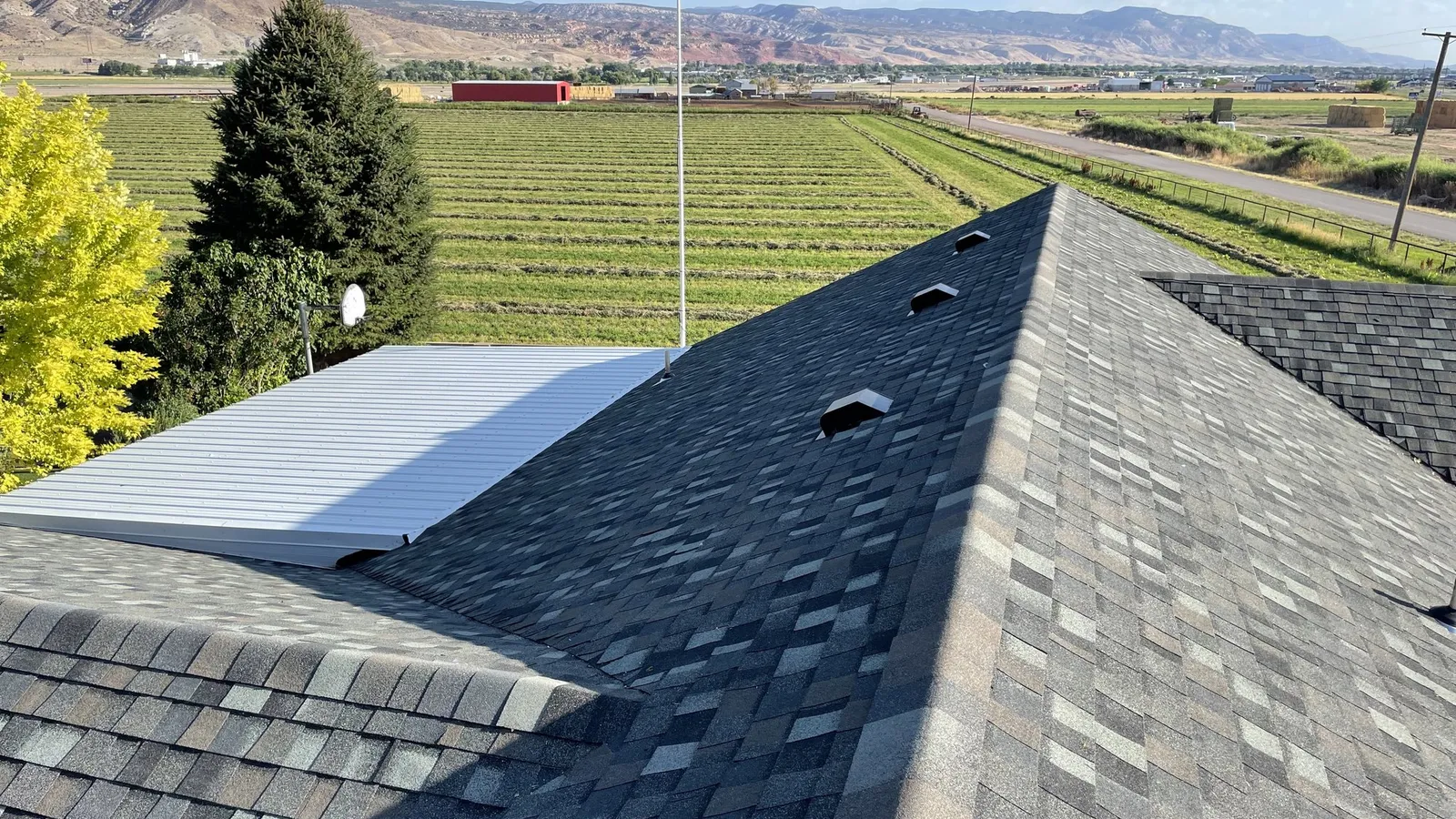
People call us asking about roof restoration in Grand Junction and mean three different things. Some mean a repair. Some mean a coating they read about. Some mean they want to avoid a full replacement and are hoping there’s a word for that. There is, and it’s worth being precise about it, because the wrong word leads to the wrong quote.
Restoration means the roof you have stays on the building and goes back into service. The structure and the decking are sound, the surface is tired, and the work brings it back rather than starting over.
On a shingle roof, that usually means a rejuvenation treatment. Asphalt shingles dry out in our sun, lose flexibility, and start shedding granules long before they fail. If the shingles are still intact and the roof isn’t leaking, a treatment that restores flexibility to the shingle can buy real years. That is what our APX Roof Renew service is. It is a rejuvenation treatment for shingle roofs that are aging but still sound. It is not a coating, and it is not a substitute for a replacement on a roof that has already failed.
On a low-slope or commercial roof, restoration usually means the membrane is intact but the seams, flashings, drains and penetrations have opened up. Those get reworked, the field gets addressed, and the roof goes back to holding water out without a tear-off. On commercial buildings that matters because a tear-off means noise, access disruption, and a week of your tenants or customers working around a crew.
On a metal roof, restoration is mostly about fasteners, seams and penetrations. Metal panels themselves last a very long time here. The screws, gaskets and sealant around vents and pipes don’t. A metal roof that’s “leaking” is usually a metal roof with a few hundred fasteners that have backed out or lost their washers, and that is a restoration job, not a replacement.
Replacement means the old roof comes off. On a house, that’s a tear-off down to the decking, any bad decking gets replaced, and a new roof goes on. On a commercial building, it’s either a tear-off or a recover over the existing membrane, depending on how many layers are already up there and what the decking looks like.
Replacement is the right answer when the surface is past the point where restoring it makes sense. Shingles that are cracked through, curling at the corners, or missing in patches. A membrane with widespread blistering or seams that have failed across the whole field. Decking that has gone soft from years of small leaks nobody caught. At that point, restoring the surface is spending money on a roof that will still need replacing soon, and we’ll say so.
The honest answer is that you can’t tell from the ground, and neither can we. A roof that looks rough from the driveway can be structurally fine with a tired surface. A roof that looks decent can have soft decking under it. Granule loss, cracked shingles, backed-out fasteners and failed seams all show up on the roof, not from the sidewalk.
So the process is the same every time. We get on the roof, photograph what we find, and walk you through it. If the roof still has years in it, we’ll tell you that, and restoration is the conversation. If it doesn’t, we’ll tell you that too, and we’ll show you the photos that make the case. Either way the inspection is free and there’s no obligation after it.
Our climate is hard on roofs in a specific way. The sun does more damage than the snow. Shingles dry out and go brittle faster here than in wetter parts of the country, which means a lot of Western Slope roofs hit the “tired but sound” stage earlier than their age would suggest. That is exactly the roof restoration is built for. The structure has years left. The surface needs help.
It also means the window doesn’t stay open forever. A shingle roof that’s a candidate for rejuvenation this year can be a replacement candidate in three if it keeps drying out. The point of an inspection isn’t to sell one or the other. It’s to know which side of that line your roof is on while you still have a choice.
If you’re in Grand Junction, Fruita, Palisade, Montrose or anywhere between and want to know which one your roof needs, book a free inspection. We’ll get up there, photograph it, and give you a straight answer. And if the answer is “neither, it’s fine,” we’ll say that too.
The inspection is free, and we photograph everything we find.