Water under a skylight in a Grand Junction winter is often condensation: warm, humid indoor air meeting cold glass. Fog between the panes means the glass seal has failed. A real leak usually comes in at the flashing and seals, not the glass. A reseal fixes sealant that has cracked; a reflash replaces flashing that water is getting around; a replacement is for a cracked, fogged, warped or worn-out unit. A reroof is one of the best times to replace a skylight.
Water under a skylight in a Grand Junction winter isn’t always a leak. Some of what lands on the floor in December comes from inside the house, not from the roof. And when it is a leak, the glass is rarely the problem. As our skylights page puts it, “Skylights fail at their flashing and seals long before the glass gives out — and our UV is hard on both.”
The Department of Energy’s Building Science Education Solution Center says “Skylights are among the most common sources of water infiltration issues in a home.” Here’s how to tell what you’re looking at, and how the three fixes, reseal, reflash and replace, line up with what’s actually wrong.
Condensation forms when warm, humid indoor air meets cold glass. VELUX, the skylight manufacturer, puts it this way: “Water vapor condenses into liquid droplets when warm, moist indoor air touches cool glass surfaces, like your skylights.” It calls interior condensation on skylight glass in the fall “normal,” and says it points to a tight, energy-efficient house rather than a leak.
Grand Junction gives condensation plenty of chances. By NOAA’s 1991–2020 climate normals for the Grand Junction airport, the average low is about 18 degrees in December and 17 in January, and the airport averages about 137 nights a year at or below freezing. Cooking, showers, a humidifier and a house full of holiday guests all add moisture to the air that meets that cold glass.
A few clues help sort it out:
If it’s condensation, the fixes are about air, not roofing. VELUX suggests running the kitchen or bathroom exhaust fan “for 15 minutes after cooking or showering,” and says to “Lower whole-home humidifier settings as outside temperatures drop.” If your skylight opens, it suggests opening it briefly each morning to let humid air out.
If none of that changes anything, or the water shows up after weather, it’s time for a look from the roof.
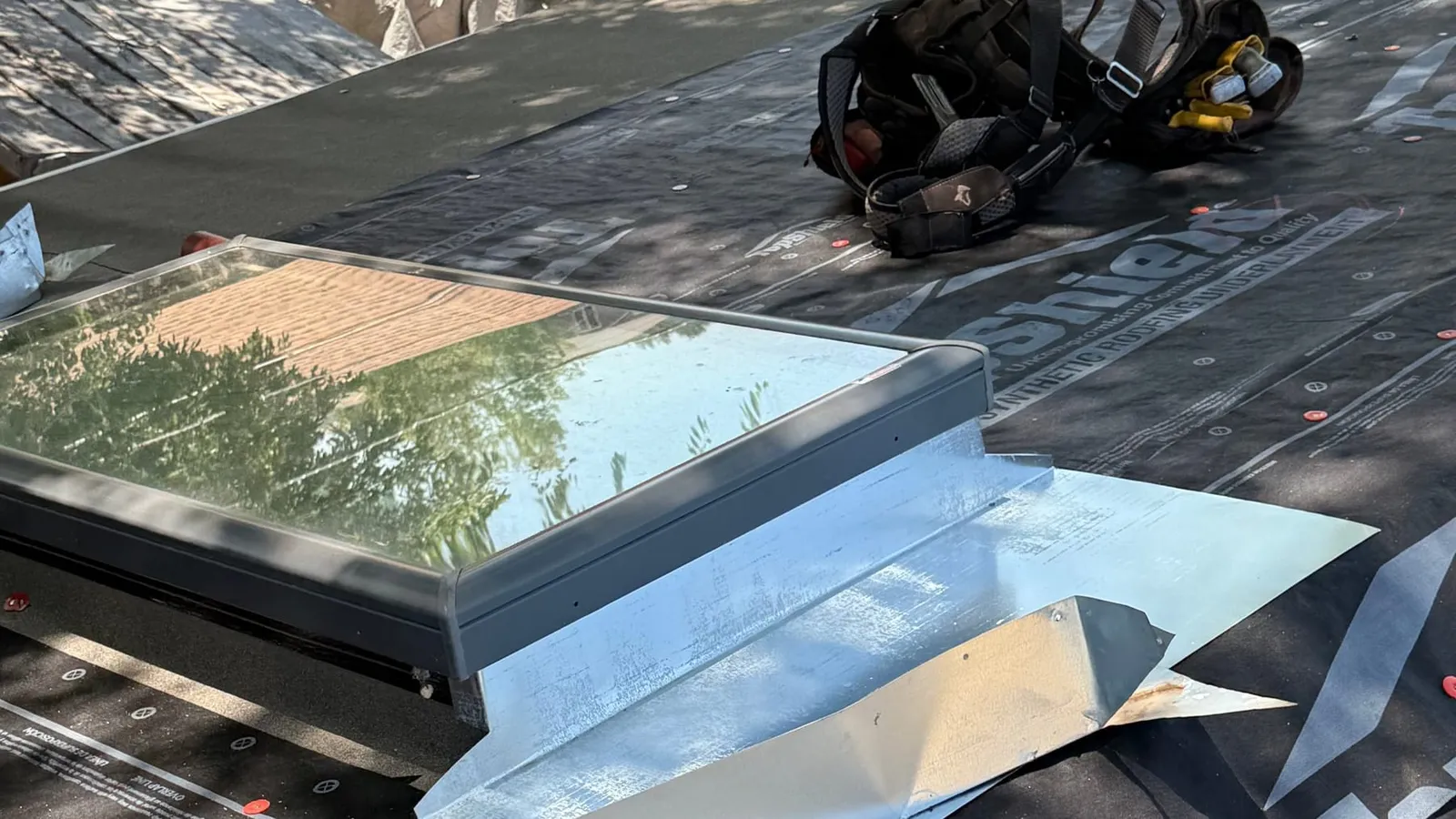
A skylight is a window set into a hole in the roof. The Solution Center calls skylights “penetrations through a roof’s water control layer.” What keeps water out of that hole is the flashing, the metal and membrane lapped into the roofing around the unit, plus the seals and gaskets on the unit itself.
Our roof repair page says skylights “leak at their flashing and seals, not usually through the glass.” For the flashing to work, it has to be layered in the right order. The Solution Center’s guidance is that “Flashing and underlayment are installed from the bottom up so upper layers overlap lower layers,” so water running down the roof always lands on top of the next piece instead of behind it.
One more thing before anyone opens the ceiling: the stain may not be under the problem. As our emergency roof repair page says, “The leak is rarely directly above the stain — water travels along the deck and the framing before it finds a way down.” A stain near a skylight is a strong hint, not proof.
Tracing the source is part of a roofer’s job. The Solution Center describes testing for leaks “by spraying the skylight unit and surrounding roof covering with a garden hose.” That’s work for someone on the roof, and our emergency page’s advice for homeowners is simple: “Stay off the roof.”
Sealant shows up in several places around a skylight: on the unit’s joints, along the edges of the flashing, over fasteners. In our sun it doesn’t last forever. Our skylights page counts “sealant that gave up a summer ago” among the small parts where most roof leaks start, and our free inspection checks “skylight seals — the small parts that fail first in our sun.”
A reseal fits when the glass is sound, the flashing is intact and lapped the right way, and the leak traces to sealant that has cracked or pulled away. It’s the smallest of the three fixes.
What a reseal can’t do is stand in for flashing. Sealant smeared over flashing that’s lapped wrong, rusted through or missing only delays the next leak. That’s why our answer on skylights pairs the two: “If the glass is sound and the leak traces to flashing or seals, a reflash-and-reseal usually solves it.”
Reflashing means taking the old flashing out and putting new flashing in, worked into the roof around it. On an existing shingle roof, that means opening up the roofing at the skylight. The Solution Center’s guidance for doing it without a new roof is that “the intent should be to cut back the existing shingles as little as needed to perform the work.” From there, the curb gets wrapped in self-adhered membrane flashing and everything is lapped bottom up.
Reflashing fits when the unit is fine and the water is coming in around it: flashing that’s bent, rusted, pulled loose, or lapped backward by an earlier repair. Done right, the skylight stays, and the path the water was taking is gone.
Some skylights aren’t worth saving. Our skylights FAQ lists the signs: “If the frame is warped, the seals have failed repeatedly, or the unit predates modern glazing, replacement during your next roof project is the smarter spend.” Two more come from the sources above:
Age counts, too. VELUX says “Many VELUX skylights can last 20 years or more,” and that “It’s best to upgrade your skylights after about 30 years because the newest models will offer innovations.” On how it’s done, VELUX says “Your installer will remove the existing skylight and flashing and replace both.” Our page describes the same job: “The old unit comes out, the opening gets fresh flashing and a weathertight seal, and a new skylight goes in — usually in a day.”
A new skylight should carry a label. The International Residential Code (2021 edition) requires unit skylights to be tested by an approved independent laboratory and to “bear a label identifying manufacturer, performance grade rating and approved inspection agency.” On a low-pitched roof, the code also raises the skylight up: on a roof with “a pitch of less than three units vertical in 12 units horizontal,” a unit skylight sits on a curb at least 4 inches above the roof, “unless otherwise specified in the manufacturer’s installation instructions.” Your local building department decides which code edition applies.
When the roof around a skylight is near the end of its life, the skylight question and the roof question become one question. VELUX says “One of the best times to proactively replace skylights is when you replace your roofing material,” and the Solution Center says that during reroofing, “installers should determine if proper flashing and other water management details are in place.”
Our skylights page puts it the same way. Skylight work “pairs naturally with a roof replacement — one crew, one schedule, one cleanup,” and skylight leaks and flashing trouble on their own “are repair work, and we handle those every week too.” Adding a skylight follows the same logic: cutting in a new one “is cleanest during a roof replacement, when the deck is already open and the flashing integrates from day one.”
So if the roof has years left, a reseal or a reflash can carry the skylight until the next roof replacement. If the roof is close to replacement anyway, that’s worth knowing before you decide how much to put into the skylight.
The sun. Grand Junction sits at about 4,600 feet, and our article on why Western Slope roofs age faster covers what that altitude does to roofing. Sealant is part of it: as our swamp cooler guide puts it, sealant “dries out and cracks in our high-altitude sun.”
The cold. Those 137 freezing nights a year make the cold months condensation season, so check the timing clues above before calling it a leak.
The snow. NOAA’s normals put the airport’s snowfall at about 18 inches a year, nearly all of it from November through March. A skylight that drips only while snow is melting on the roof is pointing at the roof, not at the air inside.
Our emergency roof repair page has the short list: “Move what’s underneath,” “Catch it, don’t fight it,” photograph everything before you clean up, and “Stay off the roof.” On the skylights page, the promise is that active leaks “go to the front of the schedule — call rather than filling out a form.”
Not by itself. VELUX calls interior condensation on skylight glass in the fall normal. Water that shows up after rain or during a thaw, stains around the opening, or peeling paint point to a leak instead.
Sometimes. If the glass is sound, the flashing is good and the leak traces to cracked sealant, a reseal is the fix. If the flashing is the problem, it needs a reflash, usually with a reseal.
The seal on the insulated glass has failed. That’s a replacement, not a reseal.
Often, yes. VELUX calls a reroof one of the best times to replace a skylight, and a new roof is the time to make sure the flashing is right. If the unit is fairly new and sound, it can stay with new flashing. We’ll tell you which yours is.
Check for condensation first: cold, dry mornings and beads on the glass point to humid indoor air, not the roof. Fog between the panes means the glass seal has failed. A real leak usually comes in at the flashing and seals, and the fix matches the failure: a reseal for cracked sealant, a reflash for water getting around the unit, a replacement for a unit that’s cracked, fogged, warped or worn out. If you’re not sure which yours is, the inspection is free.
The inspection is free, and we photograph everything we find.