Metal roofs shed snow, which is mostly good: less weight on the roof and fewer ice dams. The catch is where it lands. Snow guards hold snow on the roof so it melts off slowly instead of sliding off all at once onto a doorway, a walkway, a lower roof or a vent pipe. Grand Junction doesn't get much snow, but winter afternoons usually thaw, so snow on a sunny metal roof rarely sits for long. What matters most is what's under the eave.
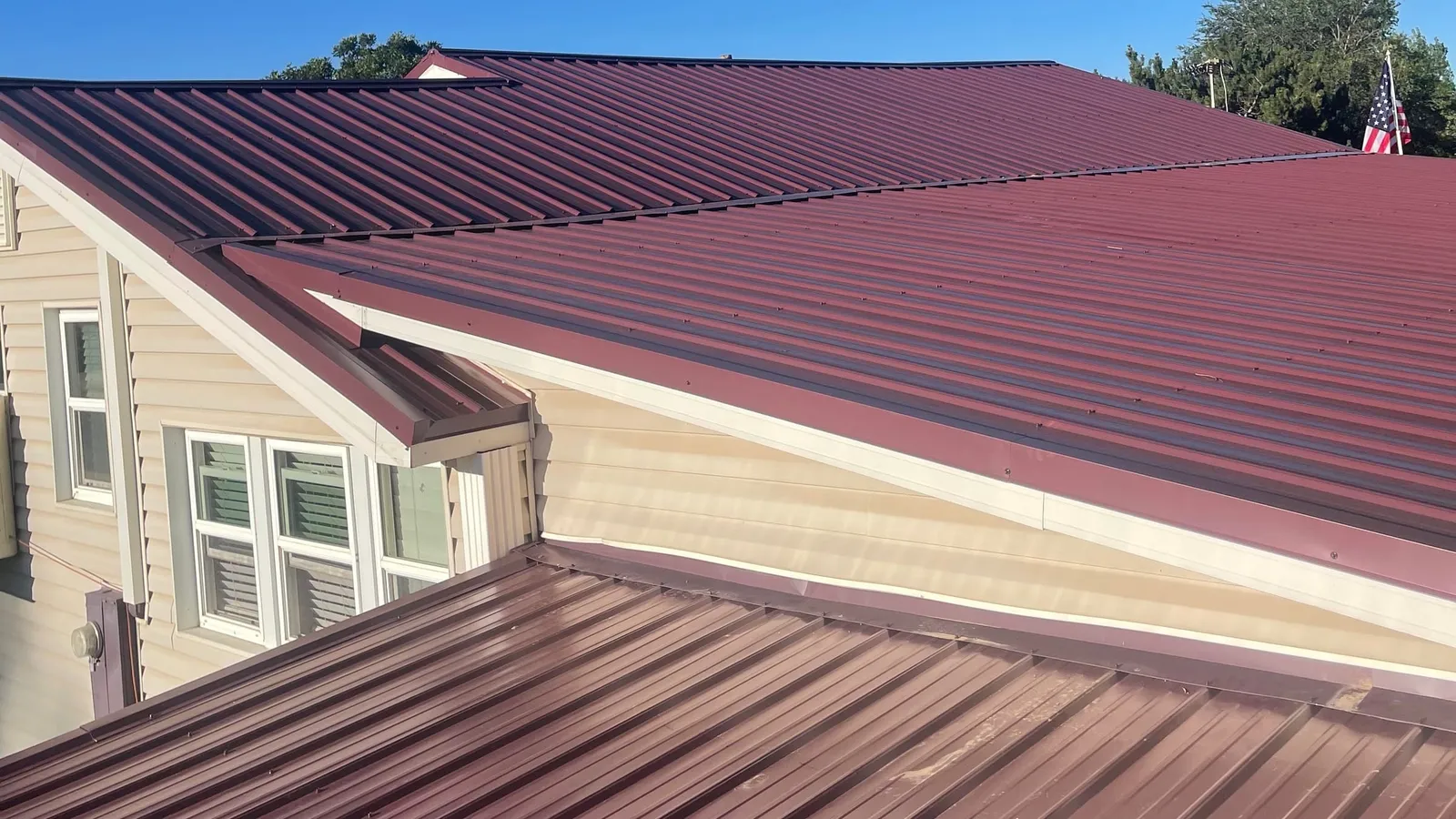
A metal roof doesn’t hold on to snow. Our metal roofing page puts it plainly: metal sheds snow instead of holding it, which means less load and fewer ice dams. That’s a real advantage. But sooner or later, every metal roof owner runs into the same question: where does the snow land when it comes off?
That’s the job of a snow guard. Here’s how they work, where they go, and what winter on the Western Slope has to do with it.
Researchers at the U.S. Army Corps of Engineers’ Cold Regions Research and Engineering Laboratory (CRREL) studied snow guards on metal roofs and opened with a simple observation: “Metal roofs are slippery.” With nothing in the way and room below the eave, snow on a metal roof tends to slide off. They count that as a plus. It lowers the risk of ice dams and shortens how long the roof has to carry the weight.
What sets a slide off is temperature. Snow forms a bond with the metal panels, and that bond weakens as the bottom of the snow warms, metal roofing consultant Robert Haddock explains in a 2004 paper. The bottom warms two ways: the sun heats the panels from above, and heat escaping from the house warms the roof from below. Once the bottom of the snow reaches 32 degrees and holds a little water, the CRREL researchers note, there’s almost no friction left between snow and metal. The whole layer can let go at once.
Shingles behave differently. FEMA’s Snow Load Safety Guide lists asphalt shingles among the rougher roof surfaces that don’t shed snow as easily, and metal panels among the slippery ones. It also notes that roofs pitched as low as 10 degrees have been seen shedding snow, so a low slope doesn’t rule a slide out.
Grand Junction isn’t buried in snow. NOAA’s 1991–2020 climate normals put the airport at about 17.7 inches a year. December is the snowiest month at about 5 inches, and only about 6 days a year bring an inch or more. Montrose, higher up, averages about 21.5 inches.
What we do have is thaw. At the Grand Junction airport, the low drops to freezing or below on about 137 nights a year, but the high stays at or below freezing on only about 18 days, and in Fruita on only about 14. The normal high in January is about 38 degrees. Add the high-desert sun on the panels, and snow on a sunny metal roof here rarely stays put for long. It tends to come down a few inches at a time, not long after it falls, and off the same edges every time.
A few inches weigh more than most people expect. FEMA puts a foot of fresh snow at about 3 pounds per square foot when it’s light and dry, and up to 21 when it’s wet and heavy. A few inches across one side of a house can add up to hundreds or even thousands of pounds, and on metal it can come off all at once. The Metal Construction Association (MCA), the metal construction industry’s trade group, warns that a sudden release can drop snow below the eaves in seconds, putting parts of the building, landscaping, vehicles and people at risk.
A snow guard holds snow on the roof so it can leave slowly, by melting and evaporating, instead of sliding off in one piece. That’s how the MCA defines the job. Guards work by holding the bottom of the snow, which is its densest layer, so a guard only a few inches tall can hold back a much deeper layer, Haddock writes.
They come in two main styles:
Both work when they’re designed and installed properly, according to Haddock. The MCA adds a caveat worth knowing: no snow guard system is 100 percent effective. A well-designed one makes a sudden slide much less likely.
Start with what’s under the eave. Snow guards earn their keep wherever sliding snow would land on something that matters:
Knowing what to protect is the first half. The second half is laying out the guards, and the details matter.
Along the eave. The MCA’s general guideline is to protect the whole eave line rather than an isolated patch of roof, and it calls guarding only a small area, such as the stretch over a doorway, potentially dangerous. The CRREL researchers explain why: when only part of a roof is guarded, the snow beside it is still free to move, and it adds to the load on those guards. The snow held back above a guard forms a wedge, so the area a guard ends up holding is bigger than it looks.
Up the slope. Snow packs densest near the eave, so that’s where the first row goes. Haddock puts it very close to the eave end of the panels, and the CRREL researchers advise keeping it off the overhang itself, where it can help ice build up at the edge. If one row can’t hold the load, more rows go in the lower half of the slope, and the CRREL researchers prefer several rows of reasonably strong guards to one very strong row at the edge.
For your roof, not a rule of thumb. How many guards, how many rows and how far apart depends on the roof’s snow load, its pitch and how far the panels run from eave to ridge. The MCA says snow retention should be engineered for each roof, with the calculations given to the owner before work starts.
We install both standing seam and Tuff Rib metal roofs, and the two take snow guards differently.
Standing seam. Standing seam panels are held by clips hidden under the seams, and they float on those clips as our temperature swings expand and contract them. Snow guards on standing seam should clamp onto the raised seams, gripping them without putting holes through the panel. The MCA says so, with only limited exceptions. CRREL warned that guards drilled through a floating panel into the structure below defeat that floating, and leaks are highly likely.
Tuff Rib and other exposed-fastener panels. These panels are already screwed through the face. On them, the MCA says snow guards should be mechanically fastened through the panel into the structure underneath, with washers and sealants as durable as the roof’s own. That puts a few more fasteners out in the sun, and they belong in the same checkup as the rest of the roof’s screws.
Glue-on guards. Skip them on metal. The MCA doesn’t recommend adhesive-mounted snow guards on any metal roof. In CRREL’s tests, hardware-store silicone didn’t last long, and guards stuck on with peel-and-stick butyl tape didn’t survive even one mild winter. Haddock adds that some of these adhesives need up to 28 days of warm weather to cure.
Materials. The MCA recommends non-corrosive metals that will last as long as the roof does. For painted steel roofs, that means structural aluminum or stainless steel. Plastic parts haven’t shown they last that long, so the MCA suggests using them only as secondary pieces, or not at all.
Snow guards are worth it when:
They’re probably not needed when:
One caution about the structure: snow guards change what the roof carries, because snow that can’t slide stays on the roof longer. A building designed to code is presumed to handle its design snow load, the MCA says, with one exception. If the structure was designed for a reduced load on the assumption that snow would slide off an unobstructed, slippery roof, snow guards shouldn’t be added. The CRREL researchers also note that a roof may need strengthening before snow guards hold snow on it. If you’re building, make sure whoever designs the structure knows snow guards are part of the plan.
If you’re planning a metal roof, bring up snow guards at the estimate. We install both standing seam and Tuff Rib and will tell you which fits your house. We’re based in Fruita and on Grand Junction roofs nearly every week.
If you already have a metal roof and you’re not sure the snow is coming down in the right places, ask about it during a free roof inspection. We check the fasteners as part of any free inspection on a metal roof, photograph what we find and give you a clear, no-obligation assessment.
It depends on what’s below the eave more than on how much snow we get. Our snow comes in small amounts, but it thaws often, so a metal roof here sheds it often. If a slope drains over a door, a walkway, a driveway or a lower roof, guards are worth it.
Ice dams start with heat. Heat lost from the house melts snow on the roof, and the water freezes again at the colder edge, University of Minnesota Extension explains. Snow guards don’t add heat, and Haddock writes that they don’t cause ice dams. The CRREL researchers do advise keeping guards off the overhang, where they can help ice build up at the edge. The fix for ice dams themselves is in the attic: air sealing, insulation and ventilation.
Generally, yes. Clamp-style guards grip the seams of a standing seam roof without making holes, and guards for exposed-fastener panels fasten through to the structure, the same as they would on a new roof. The layout should still be worked out for that roof, along with whether the structure can carry the snow the guards will hold.
Less often. Shingles don’t shed snow as easily as metal panels, FEMA notes, so a sudden slide off a shingle roof is less likely. Snow guards are mostly a metal-roof question. Our metal vs. shingle guide covers the rest of that comparison.
There’s no honest rule of thumb. The count, the spacing and the number of rows depend on the roof’s snow load, its pitch and how far the panels run from eave to ridge. The MCA says the layout should be calculated for each roof.
Metal roofs shed snow, and that’s mostly good. Snow guards decide where it goes: they hold snow on the roof so it melts off slowly instead of sliding off all at once onto a doorway, a walkway, a lower roof or a vent pipe. Around Grand Junction, winter afternoons usually thaw, so snow on a sunny metal roof doesn’t sit long, and what matters most is what’s under the eave. Clamp them to the seams on standing seam, fasten them through to the structure on Tuff Rib, skip the glue, and have the layout worked out for your roof. And if you’d like a second set of eyes on yours, the inspection is free.
The inspection is free, and we photograph everything we find.