The seller's disclosure asks about the roof's age, its warranty, and any leaks, damage or insurance claims. Colorado doesn't license home inspectors, and InterNACHI's standards let an inspector check the roof from the ground or the eaves, without walking it, predicting its remaining life or certifying it. A roof report does the most good before the earliest inspection deadline in your contract, termination or objection. In Grand Junction, high-altitude sun, rooftop swamp coolers and winter snow are the local factors. United Policyholders suggests asking your agent whether the roof is covered for replacement cost or actual cash value.
The roof is one of the few big parts of a house you can’t judge on a walkthrough. You can open the furnace closet and run the faucets, but from the driveway, a roof mostly looks like a roof. Our free roof inspection page puts the stakes simply: “The roof is one of the biggest line items in any home sale.”
Colorado’s standard purchase contract lists the roof first among the conditions a buyer can inspect and object to. That’s the Real Estate Commission’s Contract to Buy and Sell Real Estate (Residential), in the version required since January 1, 2026. Here’s how the roof fits into a home inspection in Grand Junction: what the seller has to tell you, what a home inspector does and doesn’t do on the roof, the deadlines in your contract, and what’s different about roofs here.
Under the standard contract, the seller delivers the Real Estate Commission’s Seller’s Property Disclosure by a deadline set in your contract. The current form, also required since January 1, 2026, has a section just for the roof. It asks the seller to:
Elsewhere, the same form asks about “Damage due to hail, wind, fire, flood, or other casualty,” “Any property insurance claim submitted (whether paid or not),” and any written roofing reports, with copies of the ones the seller has. Each line has a Comments column for the details, and if the house has an evaporative cooler, there’s a line for problems with it, too.
The form is also clear about its limits. The seller answers to their “current actual knowledge,” the form “is not intended as a substitute for an inspection of the Property,” and its advisory to buyers says the buyer “should thoroughly inspect the Property and obtain expert assistance.” The roof’s age is one answer a home inspection may not fill in, because under InterNACHI’s standards (more below), a home inspector isn’t required to determine it.
As of November 2026, Colorado doesn’t license home inspectors. They aren’t on the Division of Professions and Occupations’ list of the occupational professions it licenses, and a 2017 bill to make them register with the state died in a Senate committee. So there’s no state standard for what a home inspection includes. Trade associations publish their own.
InterNACHI, the International Association of Certified Home Inspectors, publishes one of those standards of practice. For the roof, it says “the inspector shall inspect from ground level or the eaves.” That covers the roof covering; the vents, flashing, skylights, chimney and other roof penetrations; and the roof’s structure, where it can be seen from readily accessible panels, doors or stairs. The inspector has to report “observed indications of active roof leaks.”
The same standard lists what the inspector is not required to do on a roof, including:
The standard also says that a component being “near, at, or beyond the end of its normal, useful life is not, in itself, a material defect,” and its general exclusions don’t require the inspector to determine the age of any component.
None of that is a knock on home inspectors, and the Real Estate Commission’s own disclosure form calls inspection services “advisable.” It just means the roof part of the report may come from the ground or a ladder at the eaves.
Colorado’s standard contract gives the buyer the right to have inspections “by one or more third parties, personally or both,” at the buyer’s expense. If the roof or anything else turns out to be unsatisfactory, three dates in your contract control what happens next:
The actual dates are whatever your contract says. A roof report does the most good in hand before the earliest of those deadlines you might use, termination or objection, with time left to read it; your agent can tell you which comes first in yours. Two more parts of the contract can touch the roof: a section on Lender Property Requirements, whose own example is “roof repair,” and a Property Insurance Termination Deadline, which lets you terminate if the availability, terms or premium of property insurance isn’t satisfactory.
We’re roofers, not brokers or lawyers. The contract itself says the parties “should consult legal and tax or other counsel before signing.”
A roofer can be one of those third parties. On our free roof inspection page, the answer to “Should I get one before buying or selling a house?” starts with “Yes” and ends with “Either way you get dated photos to negotiate with.” Whatever the reason for the call, the page says, “the inspection is the same: thorough, photographed, and free.”
Three things the page promises:
The page’s checklist runs from shingles and flashing to vents, boots, skylights and the drip edge, plus the attic and ventilation “when it matters,” and it says “Most inspections take 30–45 minutes on the roof.” It also spells out what we won’t do: “invent damage, pressure you to file a claim, or turn a free look into a sales ambush.”
A roof inspection doesn’t replace the home inspection; it covers the roof, and the home inspector covers the house. Whoever you call, our guide on how to vet any roofer applies to us, too.
“The housing stock varies a lot across town, and that’s the point of an on-roof inspection,” as our Grand Junction roofing page says. Three local things are worth knowing before you buy.
The sun ages roofs here. “High-altitude sun ages roofs on the Western Slope faster than the packaging claims,” our inspection page says, and its answer on how often a Western Slope roof should be inspected is “Once a year is the honest answer here.” That’s the backdrop for the roof age on the disclosure. Our articles on why Western Slope roofs age faster and how long a roof lasts in Colorado cover the reasons and what to expect from each material.
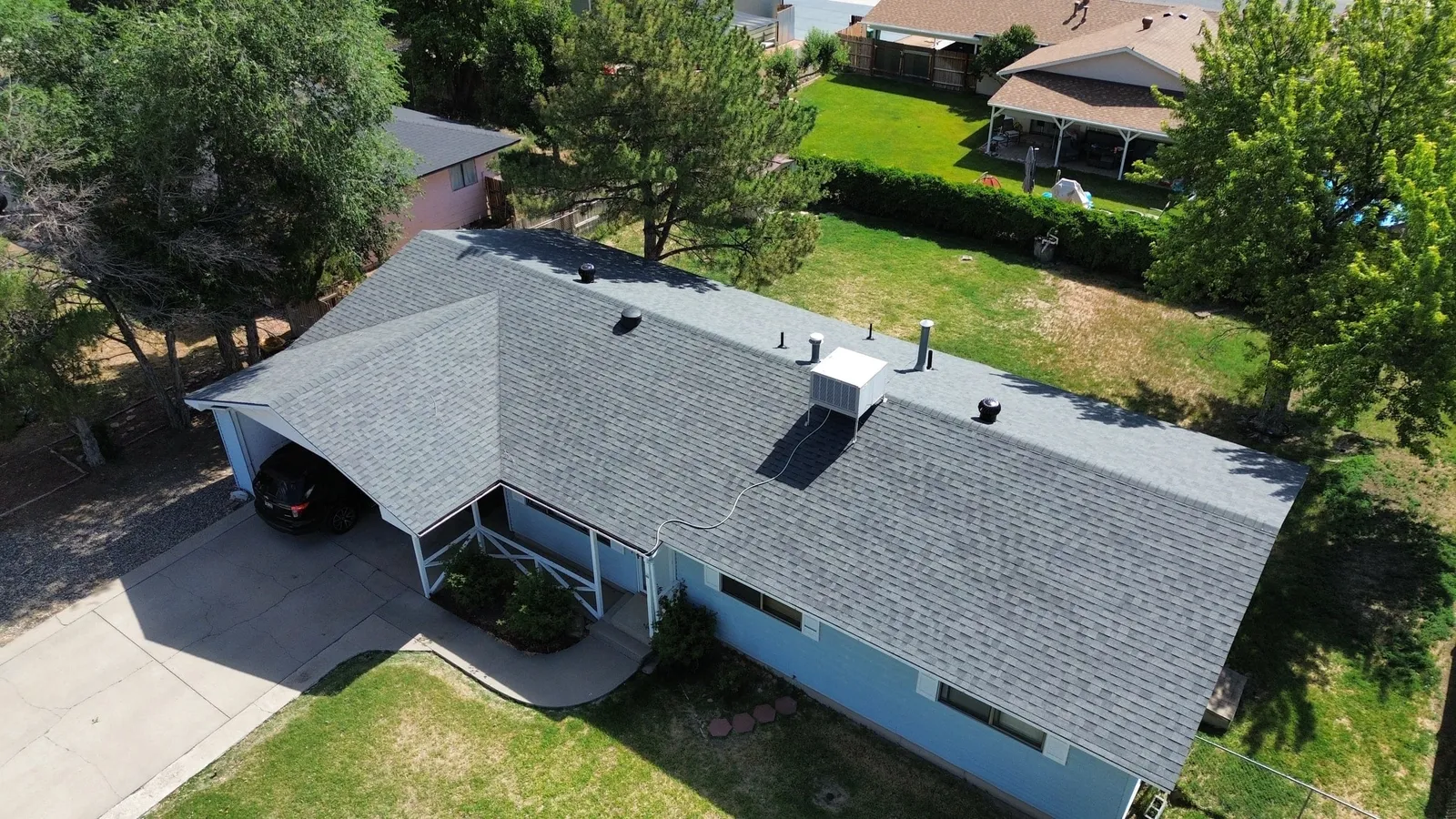
A lot of roofs here carry a swamp cooler. During a fall or winter inspection, it may not get run at all: InterNACHI’s standards don’t require an inspector to operate cooling equipment when it’s below 65 degrees outside, and the normal November high at the Grand Junction airport is about 52, by NOAA’s 1991–2020 climate normals. For the roof, what matters is the patch the cooler sits on. As our guide to winterizing a rooftop swamp cooler puts it, “The duct opening, the stand, the pan and the water lines are where swamp cooler leaks start, and most of them show up inside your house first.” That guide also lists signs you can check from inside, around the cooler’s ceiling register.
Winter limits what anyone can see. NOAA’s normals put December snowfall at the Grand Junction airport at about 5 inches, and the low drops to freezing or below on about 30 of December’s 31 nights. Snow and ice are on InterNACHI’s list of conditions an inspector isn’t required to clear. On our side, the inspection page says that if a roof is “genuinely unsafe to walk that day, we’ll tell you and document what we can another way.”
Insurance is the other place the roof shows up before closing, and the contract’s Property Insurance Termination Deadline is the date that goes with it.
United Policyholders, a nonprofit that speaks for insurance consumers, publishes a Colorado list of questions to ask your agent. One is about the roof: “Is my roof covered for Replacement or Actual Cash Value?” It follows up by asking whether there’s “wording that limits coverage related to the age or type of roof, or for cosmetic damage.” Actual cash value, as the Colorado Division of Insurance defines it, pays claims based on replacement cost “minus depreciation.” If the roof has impact-rated shingles, our Class 4 shingles article covers how Class 4 roofs, insurance discounts and cosmetic-damage exclusions fit together.
Buying a townhome or condo? The Division of Insurance says an HOA’s master policy “is written to insure the areas required by the CC&Rs” and typically covers the building structures, “including the roofs and exterior walls.” If an HOA shifts responsibility for roofs to owners, it says, the owner’s own policy has to cover them. One of the questions it lists for HOA members to ask their board is “How are individual units covered compared to common areas?”
If an inspection turns something up, the contract’s objection and resolution steps are where it gets handled, and that’s your agent’s territory. From us, you’d have the dated photos, plus “A written quote only if something actually needs work.” If the roof checks out, the page says, “you get a documented clean bill of health and a handshake.”
Once you own the house, the records are worth keeping. Our inspection page calls the dated record “gold if you ever file an insurance claim,” and among the steps the Division of Insurance lists for homeowners whose insurance has become too expensive is “Maintain and keep records for updates like roofing.”
No, as of November 2026. They aren’t on the Division of Professions and Occupations’ list of licensed occupations, and a 2017 bill to make them register with the state died in committee.
Not necessarily. Under InterNACHI’s standards, the inspector checks the roof from the ground or the eaves and isn’t required to walk on it.
InterNACHI’s standards don’t require it. Certifying or warranting the roof is on its list of things an inspector isn’t required to do, along with predicting the roof’s service life.
Our inspection page says yes: a look before a sale helps sellers “avoid surprises during the buyer’s inspection.”
The seller’s disclosure asks about the roof’s age, warranty, leaks, damage and claims, and a home inspection’s roof check can be a look from the ground or the eaves, with no estimate of remaining life. A roof report does the most good before the earliest inspection deadline in your contract, and in Grand Junction, high-altitude sun, rooftop swamp coolers and winter snow are the local factors. If you want someone on the roof before you commit, the inspection is free.
The inspection is free, and we photograph everything we find.